Offers Over & Bait Advertising: QLD Law Explained
 12 min read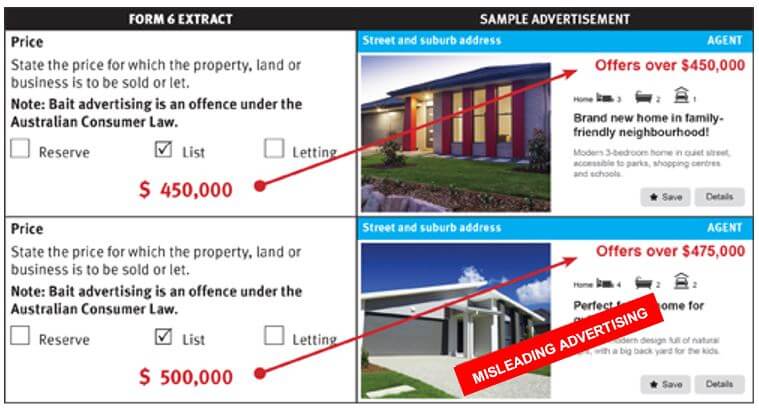
Bait Advertising and Your Form 6: The Queensland Pricing Laws Every Seller Should Understand
Most sellers think the advertised price is just a marketing decision. In Queensland, it is also a legal one.
The price your agent puts in front of buyers is tied directly to a document you sign at the very start of the campaign — the Form 6. Get that connection wrong, and it can expose your agent to serious penalties. In some situations, it can cost them the right to be paid at all. And, in narrower circumstances, it can create risk for the seller too.
This article explains how bait advertising works in Queensland property, which laws govern it and who enforces them, why the Form 6 sits at the centre of it, and the situations where price advertising can go badly wrong.
What Bait Advertising Actually Is
Bait advertising is when buyers are given a false impression about the price a seller will accept.
In property, it usually looks like a home advertised well below what the owner would ever agree to. The low number pulls in a bigger crowd. More buyers create more competition. More competition can push the final price up — or at least make the campaign look busy.
It is often dressed up as clever marketing. It isn’t. In Queensland it can be a false or misleading representation, and it is against the law.
The Queensland Office of Fair Trading is direct about this. Licensed property agents must not engage in misleading or deceptive conduct when advertising a property for sale. If an “offers over” price is used, it must be the minimum the vendor is genuinely willing to accept. Setting a price the agent knows the seller will not take is bait advertising.
The plain-English rule is simple. If you would not actually accept the advertised figure, the advertising may be misleading.
Which Laws Apply — and Who Enforces Them
This is where sellers often get lost, so here is the framework in plain terms.
Two layers of law apply to property price advertising in Queensland.
The first is state law: the Property Occupations Act 2014 (Qld). This is the Act that licenses agents, governs how they must conduct themselves, and sets the rules around the appointment document (the Form 6). It is enforced by the Queensland Office of Fair Trading, which sits within the Department of Justice and is the state regulator for real estate agents.
The second is national law: the Australian Consumer Law, which is Schedule 2 of the Competition and Consumer Act 2010 (Cth). Making a false or misleading representation about the sale of land and property is an offence under the Australian Consumer Law. It is enforced under a “one law, multiple regulators” system — the Australian Competition and Consumer Commission (ACCC) nationally, and the Office of Fair Trading here in Queensland.
In short: the Form 6 rules come from the state Act, and the misleading-price offence sits under the national consumer law. Both are in play at once, and both are enforced by the Office of Fair Trading in Queensland.
The Form 6 Is Where Your Price Is Set
The Form 6 is the official appointment between a seller and an agent under the Property Occupations Act 2014. It is the document that authorises the agent to act, sets the commission, and records your price instructions.
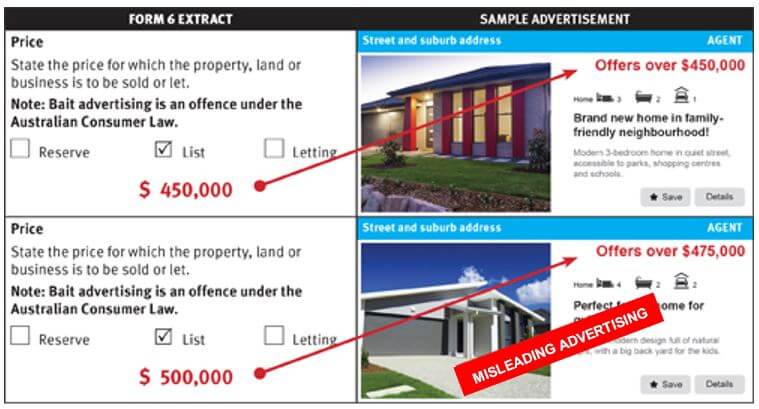
That price is not a throwaway detail. The Office of Fair Trading treats the vendor’s minimum selling price as the price noted on the Form 6. The number you write on that form becomes the reference point for whether your advertising is honest or misleading.
The Form requires a price to be recorded. You nominate a single list price, or — where the property is being marketed without a single advertised figure — a price range.
There is one important exception. Where a property is being marketed without a price, or is residential property being sold by auction, the Act (sections 214 and 216) says the agent must not disclose a price guide or what they think the property is likely to sell for. So for auction campaigns, the rule flips: no price guide at all.
The takeaway for sellers is this. Before you sign a Form 6, read the price section carefully and make sure it reflects what you would truly accept. That figure is doing legal work.
Advertising Below Your Minimum Is Not Marketing — It’s a Breach
Once your minimum is recorded on the Form 6, advertising below it is not a strategy. It is a compliance problem.
Advertising a home at a price the seller will not accept gives buyers a false impression. Under the Australian Consumer Law, making a false or misleading representation about the sale of land or property is an offence. It does not matter that the intention was to “create competition.” The test is whether buyers were misled about the price the seller would take.
The damage runs both ways. Buyers waste time and money chasing a property they were never going to get. Sellers can attract the wrong buyer pool, miss the buyers who were actually in their price bracket, and lose credibility once the market realises the advertised price was never genuine.
The Penalties Are Serious
False or misleading price advertising is not a slap on the wrist.
The Office of Fair Trading sets out the maximum penalties under the Australian Consumer Law. For a corporation, the maximum is the greater of $100 million, three times the value of the benefit received, or 30% of annual turnover during the breach period where the benefit cannot be calculated. For an individual, the maximum is up to $2.5 million per breach.
Those are ceilings, not typical outcomes. But they show how seriously the law treats misleading price conduct — and why any agent who tells you underquoting is “just how it’s done” is exposing both of you to real risk.
Can the Seller Be Fined Too?
This is the part most sellers never think about, and it’s why a good agent raises it up front.
The Office of Fair Trading is clear that it is the agent’s responsibility to make sure the seller is aware of the law. A professional agent should be explaining the bait advertising rules to you before your property goes live — not leaving you to find out later.
So can a seller actually be penalised? The honest answer is: usually not, but not never.
The Australian Consumer Law applies to conduct “in trade or commerce.” A private homeowner selling their own home is generally not regarded as acting in trade or commerce, so a one-off seller is unlikely to be personally caught by the misleading-conduct provisions. That is the protection most everyday sellers rely on without realising it.
But that shield is not absolute. There are instances where a vendor’s conduct can be in trade or commerce — for example, a builder who has built numerous homes as their source of income, or a sale connected to a business — and in those cases the Australian Consumer Law can apply to the vendor. Where that happens, the same individual penalties apply, up to $2.5 million per breach.
The practical point for every seller is this: do not ask, pressure, or allow your agent to advertise a price you have no intention of accepting. It is not a risk-free shortcut. It exposes your agent, it can taint your campaign, and depending on your circumstances it can expose you.
The Two Things That Can Cost Your Agent Their Commission
To be clear first: bait advertising by itself does not automatically cancel an agent’s commission. It is an offence under the Australian Consumer Law, with its own penalties. But two things closely connected to it can wipe out the commission — and these are the ones worth understanding.
An incorrect or incomplete Form 6
A valid, correctly completed Form 6 is what entitles an agent to commission in the first place. Without a valid appointment, an agent cannot legally claim commission — even if the property sells. Queensland courts and tribunals have refused agents their commission where the form was incomplete or the wrong form was used, on the basis that the agent was not properly appointed. If the appointment is defective, the right to be paid can disappear with it.
Soliciting offers below the price written in the Form 6
If an agent invites, encourages, or advertises offers below the figure recorded on your Form 6, they are working against the very instruction the appointment records. That can make the Form 6 inconsistent with your true instruction, and it can amount to a breach of the agent’s duty to you as their client. Misleading conduct or a breach of duty can affect an agent’s entitlement to commission. Both routes put the fee at genuine risk.
Put simply: the same conduct that misleads buyers can also undermine the document your agent’s fee depends on.
Why Some Agents Still Do It
If it’s illegal and risks the commission, why does it happen?
Because in the short term it can look like it works. A low price draws a bigger crowd. A busy first weekend feels like momentum. And there is a second, quieter tactic at play — conditioning.
When an agent brings a seller a run of low offers early, it can slowly reset the seller’s expectations. The seller starts to believe the market is softer than it is. By the time a real negotiation arrives, the seller has been quietly talked down. The offers were never really about the buyers. They were about softening the vendor.
A strong campaign does the opposite. It sets an honest price, attracts buyers who are actually in the range, and builds genuine competition between them. That is where real negotiating power comes from — not from a misleading number.
What to Check Before You Sign a Form 6
A few direct questions will tell you a lot about how an agent intends to advertise your home:
- What price is going to be written in the Form 6 as the price the property is to be sold for?
- Is the advertised price consistent with the minimum I would actually accept?
- If the property is advertised as “offers over,” is that figure genuinely acceptable to me?
- Could this advertising give buyers a false impression about what I will accept?
- Have you explained the bait advertising rules and the penalties — for you and for me?
If an agent hesitates on any of these, treat it as a warning sign.
The Bottom Line
The price on your Form 6 is not paperwork. It is the line that decides whether your advertising is honest and whether your agent has done their job lawfully.
Advertising below it is bait advertising, and it carries serious penalties under the Australian Consumer Law — enforced by the Office of Fair Trading and, nationally, the ACCC. Getting the Form 6 wrong, or soliciting offers below the price it records, can go further still and cost the agent the commission altogether. And while a private seller is usually not personally in the firing line, that protection isn’t guaranteed for everyone.
A good agent doesn’t need a misleading price to get a strong result. They set an honest figure, attract the right buyers, and let genuine competition do the work. That protects you, protects the sale, and keeps everyone on the right side of the law.
Frequently Asked Questions
What is bait advertising in Queensland real estate?
Bait advertising is giving buyers a false impression about the price a seller will accept — typically advertising a home below what the owner would ever agree to. In Queensland it can be a false or misleading representation and an offence under the Australian Consumer Law.
What does “offers over” legally mean in Queensland?
An “offers over” price should be the minimum amount the vendor is genuinely willing to accept. If the seller would not accept the advertised figure, the advertising may be misleading.
Does my Form 6 have to include a price?
Yes. The Form 6 appointment requires a list price, or a price range where a single figure isn’t advertised. The exception is auction and no-price campaigns, where the agent must not disclose a price guide at all.
Can my agent advertise my home for less than I’ll accept?
No. Advertising below the minimum recorded on your Form 6 can amount to bait advertising and a false or misleading representation under the Australian Consumer Law.
Can a seller be fined for bait advertising?
Usually not. A private homeowner selling their own home is generally not acting “in trade or commerce,” so is unlikely to be personally caught. But that protection isn’t absolute — vendors whose sale is connected to a business, such as builders or developers, can be liable, with individual penalties up to $2.5 million per breach. It is the agent’s responsibility to make sure the seller is aware of the law.
Can bait advertising affect my agent’s commission?
Bait advertising by itself doesn’t automatically cancel commission, but two related things can: an incorrect or incomplete Form 6, and soliciting offers below the price written in the Form 6. Both can jeopardise the agent’s right to be paid.
Who enforces these laws in Queensland?
The Queensland Office of Fair Trading (within the Department of Justice) enforces the Property Occupations Act 2014 and the Australian Consumer Law in Queensland. The ACCC is the national regulator of the Australian Consumer Law.
Sources, Legislation and Where to Verify This Yourself
- Queensland Office of Fair Trading — Property advertising guidance
- Queensland Office of Fair Trading (Department of Justice)
- Property Occupations Act 2014 (Qld)
- Competition and Consumer Act 2010 (Cth) — the Australian Consumer Law is set out in Schedule 2
- Australian Competition and Consumer Commission (ACCC)
- Office of Fair Trading forms — including the Form 6 appointment
This article is general information only and is based on publicly available Queensland Office of Fair Trading guidance and legislation. It is not legal advice. Sellers, buyers and agents should seek independent legal advice about their specific circumstances.
Knowing the right questions is half the protection
and most sellers don’t discover what they didn’t ask until it’s too late to matter. Our Seller Survey is a simple way to get ahead of that. It takes five to ten minutes, and by the end you’ll see clearly what you already understand about selling, where the gaps are, and the exact questions worth putting to any agent before you sign a Form 6. From there, one of our consultants can walk you through your answers, explain what they mean for your sale, and point you to further resources — so your decisions are made with full information, not under pressure. Take the Seller Survey and find out where you stand.