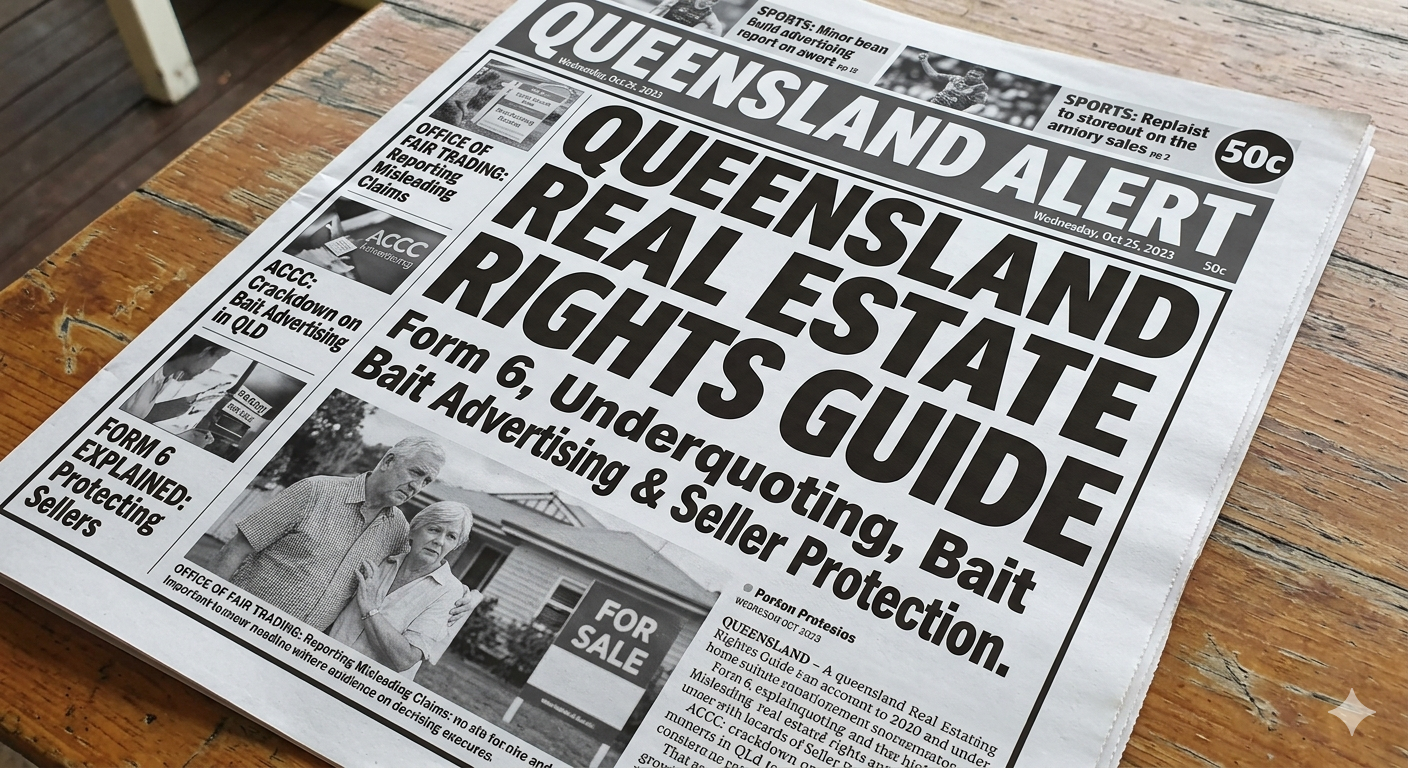
Queensland Real Estate Rights Guide | Form 6, Underquoting, Bait Advertising & Seller Protection
 9 min read
 Queensland Real Estate Rights Guide
What Buyers And Sellers Need To Know Before Signing Anything
Important Disclaimer
This article is educational and investigative in nature only and does not constitute legal advice, financial advice or regulatory advice. Readers should seek independent legal advice, conveyancing advice or contact the Queensland Office of Fair Trading regarding their own circumstances.
The legislation, regulatory guidance and industry commentary discussed in this article may change over time. Readers should independently verify all legislation and regulatory references before relying on any information contained in this article.
Not all real estate professionals engage in the conduct discussed in this article. Many agents operate ethically and professionally. This article focuses on transparency, compliance obligations, consumer awareness and risk management for Queensland property buyers and sellers.
Why Trust In Real Estate Has Declined
According to Roy Morgan ethics and honesty research, real estate agents have consistently ranked among the least trusted professions in Australia. Public concerns often revolve around misleading pricing, underquoting, hidden marketing costs, pressure tactics, disclosure issues, commission disputes and transparency concerns.
This article is not intended to attack the industry. The purpose of this guide is to help Queensland consumers better understand the legal documents, pricing structures, disclosure obligations and risks involved before signing legally binding agreements.
What Is A Form 6?
In Queensland, a Form 6 is the official appointment and reappointment form used under the 🔗Property Occupations Act 2014.
The Form 6 is not simply an administration form. It is the legally binding appointment between the seller and the real estate agency.
The Form 6 governs:
- Commission entitlement
- Exclusive listing periods
- Marketing authority
- Advertising instructions
- Appointment dates
- Continuing authority periods
- Pricing instructions
- Seller liability for marketing expenses
Most sellers focus heavily on their contract of sale but never independently review their Form 6 appointment. This can become a major problem because the Form 6 controls many of the financial and legal obligations between the seller and the agency.
The Pricing Section In Form 6 Matters
One of the most important sections in the Form 6 appointment is Part 4 Section 3, which states:
“State the price for which the property is to be sold or let.”
This wording is extremely important because Queensland Office of Fair Trading guidance states:
“The vendor’s minimum selling price is the price they’ve noted on Form 6.”
Source:
🔗Queensland Office Of Fair Trading Property Advertising Guidance
This effectively makes the Form 6 pricing section the pricing anchor for the appointment.
If the seller’s instructions change, the written pricing instructions become the reference point from which future instructions and advertising conduct may later be assessed.
Auction campaigns are treated differently under the Form 6. The form specifically provides separate wording and reserve price provisions for auction campaigns, including situations where reserve pricing may be supplied later in writing.
That distinction is important because non auction campaigns appear intended to have pricing instructions documented from the commencement of the appointment.
Why Ambiguous Pricing Creates Risk
Many complaints and disputes within the industry involve vague wording in the pricing section of the Form 6 such as:
- Offers
- Offers over
- Contact agent
- By negotiation
Consumers should understand that Queensland Office of Fair Trading guidance directly ties advertising conduct to the seller’s minimum acceptable price noted on the Form 6.
This raises important compliance questions where pricing instructions are vague, unclear or not properly documented.
If there is no clear pricing anchor, disputes may later arise regarding:
- Seller instructions
- Advertising compliance
- Soliciting lower offers
- Bait advertising
- Commission entitlement
Sellers should carefully review how pricing instructions are recorded and seek independent legal advice if uncertain.
Underquoting And Bait Advertising
Queensland Office of Fair Trading states:
“Giving buyers a false impression about the price a seller will accept is known as bait advertising.”
Source:
🔗Queensland Office Of Fair Trading Property Advertising Guidance
Australian Consumer Law also prohibits misleading or deceptive conduct in trade or commerce under:
🔗Australian Consumer Law Section 18
Historically, penalties commonly referenced under Australian Consumer Law included fines of up to $220,000 for individuals and $1.1 million for corporations for misleading conduct and bait advertising. Penalties under Australian Consumer Law have since increased substantially and may now be significantly higher depending on the conduct and circumstances.
If a seller’s minimum acceptable price is documented in the Form 6 and an agent knowingly solicits materially lower offers, serious compliance concerns may arise involving:
- Bait advertising
- Misleading conduct
- Breach of seller instructions
- Commission disputes
Consumers should also understand that there is no automatic “10 percent negotiation rule” allowing agents to advertise below seller instructions.
Older appraisal methodology concepts are often misunderstood and incorrectly applied to advertising conduct.
Sellers Can Also Be Exposed To Risk
Many sellers incorrectly believe that only the real estate agent carries legal responsibility for misleading advertising or pricing conduct.
Queensland Office of Fair Trading guidance makes it clear that misleading pricing representations and bait advertising may breach Australian Consumer Law.
While agents and agencies are typically the primary focus of enforcement action, sellers should also understand that knowingly participating in misleading conduct or providing false information may expose them to legal risk.
If a seller knowingly participates in:
- False pricing representations
- Misleading advertising
- Artificially low bait pricing
- False representations regarding offers
- Concealment of material facts
they may potentially expose themselves to legal consequences under Australian Consumer Law depending on the conduct and circumstances.
Sellers should therefore be cautious about following advice or instructions that appear inconsistent with Queensland Office of Fair Trading guidance or Australian Consumer Law obligations.
The “10 Percent Rule” Myth
One of the most common misconceptions in Queensland real estate is the belief that a property can legally be advertised at up to 10 percent below the seller’s actual minimum acceptable price and then “negotiated up”.
Many buyers and sellers have heard statements such as:
- “We can advertise it lower to attract more buyers.”
- “There is a 10 percent negotiation buffer.”
- “We will list it lower and talk buyers up.”
- “Everyone does it.”
Consumers should understand that Queensland Office of Fair Trading guidance does not support the idea that agents are automatically permitted to advertise materially below the seller’s actual acceptable price simply because they intend to negotiate upwards later.
Queensland Office of Fair Trading states:
“The vendor’s minimum selling price is the price they’ve noted on Form 6.”
Queensland Office of Fair Trading also states:
“Giving buyers a false impression about the price a seller will accept is known as bait advertising.”
Source:
🔗Queensland Office Of Fair Trading Property Advertising Guidance
The origin of the so called “10 percent rule” appears to come from older appraisal methodology concepts under previous legislative frameworks, where agents and valuers commonly relied on comparable sales evidence and estimated market ranges when forming appraisals.
That appraisal methodology is very different from advertising conduct.
An appraisal is an opinion of value based on comparable sales, market conditions, location, presentation and seller circumstances.
Advertising a property below the seller’s actual minimum acceptable price in order to attract enquiry may raise entirely different issues involving:
- Underquoting
- Bait advertising
- Misleading conduct
- False price representations
- Breach of seller instructions
Consumers should therefore be cautious when hearing claims that agents are automatically allowed to advertise properties below the seller’s acceptable price because there is a “10 percent negotiation allowance”.
Queensland Office of Fair Trading guidance focuses on the seller’s minimum acceptable price and the representations being made to the public, not simply on whether a property might eventually negotiate higher.
This becomes particularly important where the seller’s pricing instructions are documented in the Form 6 appointment because the Form 6 may later become a key reference point regarding:
- Seller instructions
- Advertising conduct
- Commission disputes
- Compliance obligations
- Potential misleading representations
Sellers should insist that pricing instructions are clearly documented in writing and should seek independent legal advice if uncertain about how their property is being marketed.
Can Commission Entitlement Be Challenged?
There have been disputes where sellers have challenged commission entitlement due to alleged non compliance, ambiguous instructions or conduct inconsistent with written seller instructions.
Whether commission remains payable depends on the specific facts, conduct and legal circumstances of each matter.
Sellers should understand that the Form 6 is not a document to sign casually. It should be independently reviewed, particularly where:
- Pricing instructions are unclear
- Marketing obligations are unclear
- Exclusive authority clauses exist
- Continuing authority periods apply
- Commission triggers are broad
Multiple Offers And Buyer Rights
Queensland buyers should understand that multiple offer situations have formal procedures.
If buyers are told there are multiple competing offers they should request written confirmation that they are participating in a multiple offer situation.
Buyers should:
- Keep written records
- Document communications
- Request clarification in writing
- Understand that sellers may negotiate with one buyer, multiple buyers or none
Agents are not necessarily required to disclose the confidential details of competing offers, however misleading representations may still create compliance concerns.
The One Question Every Buyer Should Ask
“Do you have knowledge of anything that may influence my decision to buy this property?”
This question should preferably be asked in writing.
This may include:
- Known defects
- Water ingress
- Structural concerns
- Flooding history
- Insurance issues
- Body corporate disputes
- Unapproved works
- Prior inspection reports
- Termite issues
Consumers should also carefully review the Queensland Form 2 Seller Disclosure Statement:
Marketing Budgets And Deferred Marketing Risks
Many sellers do not fully understand vendor paid advertising obligations.
Consumers should understand:
- “No upfront marketing” does not always mean “no liability”
- Deferred payment systems may still leave the seller liable
- Campaign finance providers may still require payment if the property does not sell
- Withdrawal conditions matter
- Exclusive listing conditions matter
Sellers should request:
- Fully itemised marketing schedules
- Supplier breakdowns
- Written clarification regarding liability
- Clarification regarding referral benefits or rebates
Referral Fees And Disclosure Obligations
Consumers should ask:
“Does the agency receive any financial or non financial benefit from recommending this provider?”
This may include:
- Conveyancers
- Mortgage brokers
- Building and pest inspectors
- Campaign finance providers
- Stylists
- Tradespeople
- Photographers
Recommendations are not automatically improper, however transparency matters and consumers should understand whether referral relationships exist.
Building And Pest Inspection Risks
Buyers should not automatically rely on a single recommended inspector.
Buyers should:
- Obtain multiple recommendations
- Research inspectors independently
- Ask whether referral relationships exist
- Carefully review inspection reports
🔗https://goldcoastrealestateagents.au/building-and-pest-reports-in-qld/
Buying The Listing
Some sellers complain that properties are over appraised to win the listing, then conditioned downward later.
Sellers should request:
- Comparable sales evidence
- Recent local comparable sales
- Written appraisal methodology
Consumers should also remember that sale prices are affected by:
- Seller motivation
- Market conditions
- Forced sales
- Property condition
- Location
Red Flags Sellers Should Watch For
- Vague pricing instructions
- Missing Form 6 documentation
- Pressure to sign immediately
- Verbal only instructions
- Unclear marketing obligations
- Hidden fees
- Unexplained rebates
- Refusal to provide written confirmations
- Drastic price conditioning after signing
Red Flags Buyers Should Watch For
- Unverifiable multiple offer claims
- Pressure tactics
- Missing disclosure information
- Rushed inspections
- Discouragement from independent advice
- Vague pricing campaigns
Questions Buyers And Sellers Commonly Ask
Does there have to be a price written in my Form 6?
The approved Form 6 wording states:
“State the price for which the property is to be sold or let.”
Auction campaigns are treated separately under the form. Sellers should carefully review how pricing instructions are documented and seek independent legal advice if uncertain.
Can an agent advertise my property below the price I will accept?
Queensland Office of Fair Trading guidance states that advertising below the seller’s minimum acceptable price may constitute bait advertising or misleading conduct.
Can I still be liable if my agent gives me poor advice?
Potentially, yes. Sellers should understand that knowingly participating in misleading conduct or providing false information may expose them to legal risk depending on the conduct and circumstances.
Do I still have to pay marketing if my property does not sell?
Possibly. Some deferred vendor paid advertising arrangements may still leave the seller liable even if the property does not sell.
Can an agent change my price without permission?
Sellers should insist all pricing and strategy changes are authorised and documented in writing.
Can agents receive referral fees?
Referral relationships and benefits may exist. Consumers should ask whether any financial or non financial benefit is received from recommendations.
Should I use the agent’s preferred building inspector?
Buyers should independently research inspectors and obtain multiple recommendations before making a decision.
What should I do if I think I have been misled?
Keep written records, screenshots, emails and communications and contact the Queensland Office of Fair Trading or seek independent legal advice.
Complaint Pathways
Queensland Office Of Fair Trading:
🔗https://www.qld.gov.au/law/fair-trading
Australian Competition And Consumer Commission:
Queensland Legislation:
Final Thoughts
The most important thing buyers and sellers can do is slow down, ask questions, request written confirmation and independently verify information before signing legally binding agreements.
Consumers should understand that:
- The Form 6 matters
- Pricing instructions matter
- Marketing liability matters
- Disclosure matters
- Written records matter
- Transparency matters
This article is not about attacking an industry. It is about helping Queensland consumers better understand the legal documents, pricing structures, disclosure obligations and protections involved in one of the largest financial transactions most Australians will ever make.