Unwanted Real Estate Calls
 10 min read
 Stop Unwanted Real Estate Calls: Your Rights in Queensland
Can a real estate agent keep calling you after you’ve told them to stop? No, not lawfully. One polite, identified marketing call is not automatically unlawful. But once you have clearly asked an agency to stop contacting you, that request should apply to the whole agency, its employees, contractors, callers and related entities, not just the one salesperson who happened to phone you first.
Here’s what people often get wrong on both sides of this. A homeowner does not hand over open-ended permission for marketing contact simply because their home is listed for sale, their ownership details sit on a public property record, or they once walked through an open home years ago. And an agency does not get to treat a “stop calling me” request as applying only to whichever staff member said it out loud to them.
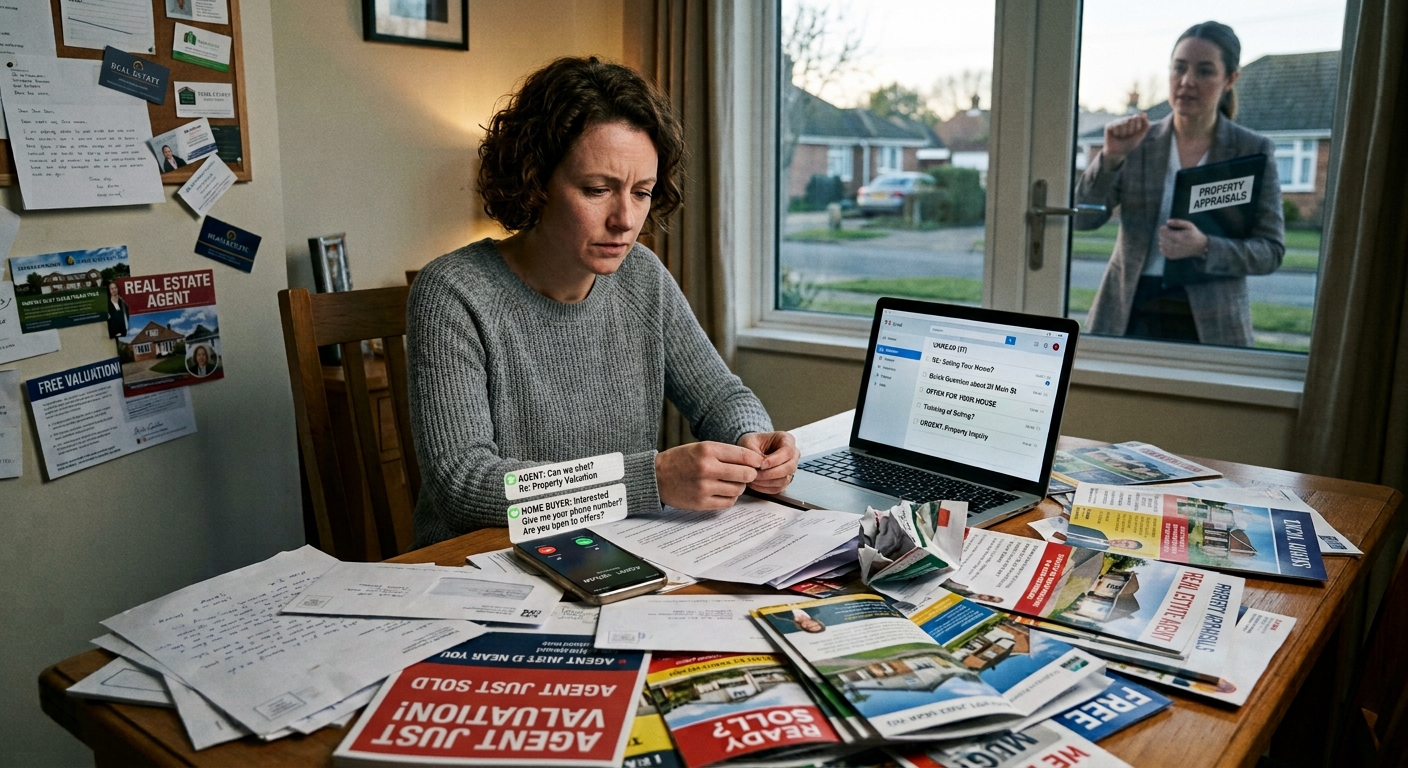
Repeated calls after a clear opt-out, staff rotation used to get around a do-not-contact request, doorstep visits, or persistent messaging can move from being an annoying marketing overreach into a privacy complaint, a telemarketing breach, a professional-conduct issue, or, in serious cases, a police matter.
This article walks through where your personal information legally comes from, what an agency can and can’t do with it, what “stop” actually means in law, and exactly who to contact if it keeps happening, with a direct link and a copy-paste template next to each one.
This is general information for Queensland residents, not personalised legal advice. If your situation involves threats, fear for your safety, or a pattern of conduct you are worried about, get independent legal advice or contact the services listed below.
How Agencies Actually Get Your Details
Real estate businesses collect personal information from a mix of sources:
- Open-home sign-in sheets showing name, phone number and email
- Online enquiries, including portal enquiry forms and “email me updates” requests
- Property-data platforms that aggregate ownership, sales and valuation data
- Public records, which are searchable to a degree
- Purchased marketing lists from third-party data providers
None of these sources give an agency a blank cheque. Under the Privacy Act 1988 (Cth) and the Australian Privacy Principles, collection has to be reasonably necessary and by fair, lawful means, and what happens to your information afterwards is still governed by rules, regardless of where it came from.
What the Privacy Act Actually Requires
A few Australian Privacy Principles matter most here. APP 3 requires collection to be reasonably necessary for the agency’s functions, and gathered lawfully and fairly. APP 5 requires that at or before collecting your information, or as soon as practicable after, an agency takes reasonable steps to tell you who is collecting it, why, who it might be disclosed to, and how to see their privacy policy. APP 6 means information collected for one purpose cannot simply be reused for a different purpose unless an exception applies. APP 7 sets out direct marketing rules, including your right to opt out and to ask where an organisation got your details.
Here is the principle worth remembering:
Attending an open home does not amount to open-ended permission for an agency to build a long-term seller-prospecting file.
A privacy notice is not the same thing as consent. The law does not require every open-home sheet to carry a tick box, but a clear collection notice paired with a separate, specific marketing permission is a far stronger and more transparent practice than a bare “name, mobile, email” sheet with no stated purpose.
If you want to complain about how your information was collected or used, this goes to the OAIC, see the Privacy Complaint template and link further down this page.
Bought Lists and Third-Party Data
Agencies can lawfully obtain information from public records, data platforms or purchased lists. But obtaining it is not the same as having unlimited licence to use it however they like.
A property being listed for sale does not itself give rival agencies permission to repeatedly call, text, email or visit the owner. If you have never dealt with an agency before, you are a third-party-data case, and their obligations under the Privacy Act still apply. You can ask an agency where they got your information, and they should generally be able to tell you, though there are limited circumstances where doing so may not be required. A bought list is not a licence to ignore opt-outs.
Telephone, SMS and Email: Different Rules for Each Channel
Three separate pieces of law cover different types of unwanted contact. Phone calls are covered by the Do Not Call Register Act 2006 and the Telecommunications (Telemarketing and Research Calls) Industry Standard 2017. Email and SMS are covered by the Spam Act 2003. General collection, use and disclosure of personal information is covered by the Privacy Act 1988 and the Australian Privacy Principles.
Telemarketers must identify themselves and the organisation they are calling for, explain why they are calling, display accurate caller ID, call only within permitted hours, and end the call if you ask them to or indicate you do not want to continue.
Permitted telemarketing hours are Monday to Friday from 9 am to 8 pm, Saturday from 9 am to 5 pm, with no telemarketing calls permitted on Sundays or national public holidays.
Registering with the Do Not Call Register is free and covers home, mobile and fax numbers. Businesses may need up to 30 days to remove a newly registered number from their calling lists, so a call in the first month after registering is not necessarily a breach.
If a number on the Register keeps getting called, lodge a complaint directly here: Do Not Call Register, lodge a telemarketing complaint. For spam texts or emails, complain to the ACMA spam and telemarketing team.
To be clear, cold calling is not automatically illegal. But calling a number that is on the Do Not Call Register without valid consent can breach the Act, and every telemarketer has to comply with the Industry Standard regardless of whether a number is registered.
I Told Them to Stop Calling. What Now?
This is the part most people get wrong, on both sides.
Make your request clearly, and put it in writing to the agency’s principal or licensee, or its privacy contact, not just the individual who called you. Your request should cover the agency’s employees, contractors, related entities and anyone acting on its behalf.
Changing who calls you does not make it acceptable. If you have told an agency not to use or disclose your information for direct marketing, they should not get around that by handing your number to a different staff member or a related business.
Use the template below to make this request unambiguous.
Template: Agency-Wide Do Not Contact Request
Subject: Do Not Contact / Direct Marketing Opt-Out
I withdraw any consent for your agency, its employees, contractors and related entities to contact me for marketing or prospecting.
Do not call, text, email, door-knock or use my personal information for direct marketing. Do not disclose my personal information to another person or organisation for that purpose.
Please place my details on your internal do-not-contact list, confirm this in writing, and tell me the source of my personal information.
Name:
Mobile/email:
Address, if relevant:
Date:
If the agency ignores this or keeps contacting you afterwards, follow up with a formal complaint to the Office of the Australian Information Commissioner using the Privacy Complaint template further down this page.
Door-Knocking, Letterbox Drops and Home Attendance
Context matters a lot here.
One generic, unaddressed letterbox drop is not automatically a privacy or criminal-law breach. One polite knock at the door is not automatically unlawful either. But after you have clearly told an agency not to contact you, repeated targeted calls, texts, emails, door-knocks, home visits or material placed in your mailbox can start building a pattern that is worth taking further.
Queensland’s Criminal Code 1899 sets out the offence of unlawful stalking, intimidation, harassment or abuse in section 359B. Broadly, it covers conduct that is intentionally directed at a person, engaged in on more than one occasion or on one occasion if protracted, and includes following, loitering near, watching or approaching a person, contacting them in any way, approaching or entering somewhere they live, work or visit, or intimidating, harassing, threatening, humiliating or abusive acts.
The conduct also has to cause a recognised type of harm or fear. This can include serious mental, psychological or emotional harm, or preventing or hindering someone from doing something they are entitled to do, or compelling them to do something they are entitled to refuse.
Importantly, section 359D preserves reasonable conduct carried out in a lawful trade, business or occupation. So not all repeated marketing is stalking. The question comes down to context, persistence, targeting, reasonableness, and the actual effect on the person receiving it.
At a Commonwealth level, section 474.17 of the Criminal Code Act 1995 makes it an offence to use a carriage service, such as phone, SMS or email, in a way that reasonable people would regard, in all the circumstances, as menacing, harassing or offensive.
Ordinary unwanted marketing is usually a telemarketing and privacy issue first, not automatically a police matter. Threats, intimidation, repeated targeted attendance, stalking-type behaviour or conduct causing fear should be reported to Queensland Police.
For serious cases, report to Policelink for non-urgent matters, or call 131 444. For immediate danger, call 000. Use the Police Incident Timeline template further down this page to keep your record straight before you report.
What Does and Does Not Invite Future Contact?
May Reasonably Invite Follow-Up
- Asking for a contract, price guide, callback, market report or property information
- Making an online enquiry and agreeing to receive updates
- Giving details at an open home where the purpose and follow-up are clearly disclosed
- Ticking a separate marketing-consent box
- Asking an agent to call again at a specific time
- Having an existing relationship with the agency, provided no opt-out has been made
Does Not Give Open-Ended Permission
- Having a home listed for sale
- Being identifiable from public ownership or property-data records
- Answering one unexpected phone call
- Passing an open home without giving details
- Signing an open-home sheet with no stated collection purpose or privacy notice
- Saying “not interested” to one salesperson
- Telling an agency to stop contacting you
- Registering your number on the Do Not Call Register
These examples describe reasonable expectations on both sides. They are not an excuse for poor agency behaviour, and they are not a reason to assume the worst about every marketing call either.
Copy-and-Paste Templates, With Where to Send Each One
1. ACMA / Do Not Call Register complaint notes. Use before lodging at donotcall.gov.au or acma.gov.au/spam.
Keep a record with: the number called; date and time; caller’s name and agency; number displayed; what was said; whether the number was on the Do Not Call Register; whether the caller was told to stop; and screenshots, voicemail or call-log evidence.
2. Privacy complaint to the agency. Send to the agency first. If unresolved after 30 days, escalate at the OAIC.
Subject: Privacy Complaint
I am writing to make a formal privacy complaint. Please confirm all direct-marketing suppression actions taken on my details, identify the source of my personal information, explain the purpose for which it was collected and used, identify any people or entities to whom it has been disclosed, stop any further use or disclosure of my information for direct marketing, and provide a written response within 30 days.
Name:
Contact details:
Date:
3. Office of Fair Trading complaint summary. Lodge at qld.gov.au, make a consumer complaint.
State facts only. Attach evidence. Avoid exaggeration. Include the agency and salesperson name, property or address if relevant, dates of contact, contact method, and the outcome sought.
4. Police incident timeline (serious cases only). Report at Policelink, call 131 444, or call 000 for immediate danger.
Keep a simple chronological log of date, time, what happened, and any evidence.
Where to Get Help or Make a Complaint
- Do Not Call Register, register your numbers
- Do Not Call Register, lodge a telemarketing complaint
- ACMA, spam and telemarketing information and complaints
- OAIC, lodge a privacy complaint
- Queensland Office of Fair Trading, make a consumer complaint
- Queensland Police / Policelink, non-urgent reporting, or call 131 444
- Emergency: 000
Evidence Checklist
Before you complain anywhere, gather what you can. Screenshot texts and emails. Keep voicemail recordings. Screenshot call logs. Write down the date, time, caller, agency and number used. Retain copies of every opt-out request you have sent. Photograph any repeated door-knocking material or letters. Obtain CCTV footage where available. Keep the facts chronological, and avoid making public accusations before a regulator has assessed the matter.
The Bottom Line
You are entitled to set boundaries around who contacts you and how. Ethical agencies will identify themselves clearly, respect your privacy, honour opt-outs the first time, and stop when asked. This is not about shutting down legitimate competition between agencies, it is about making sure that competition stays respectful, transparent and lawful.
If you would like general guidance on understanding your rights in a situation like this, Gold Coast Real Estate Agents is happy to talk it through, with no pressure, and without this being legal advice.
Frequently Asked Questions
Can a real estate agent call me after I’ve asked them to stop?
No. Once you have clearly asked an agency to stop contacting you for marketing purposes, continued calls, texts or emails can breach the Privacy Act, the Do Not Call Register Act, or the Spam Act, depending on the channel used.
Does listing my house for sale give other agents permission to contact me?
No. A property being listed for sale does not itself create permission for rival agencies to repeatedly call, text, email or visit the owner.
What is the difference between a privacy complaint and a Do Not Call complaint?
A Do Not Call complaint, lodged at donotcall.gov.au, is specifically about telephone calls or faxes to a registered number. A privacy complaint, lodged at oaic.gov.au, covers broader issues, such as how your information was collected, used or disclosed.
Is it stalking if an agent keeps contacting me after I’ve said no?
Not automatically. Ordinary unwanted marketing is usually a telemarketing and privacy issue first. It may become a stalking, intimidation or harassment matter under section 359B of the Criminal Code if the conduct is repeated, targeted, and causes fear or genuine detriment, assessed on the specific facts.
Who do I complain to about a Queensland real estate agent’s conduct?
The Queensland Office of Fair Trading handles complaints about real estate licensees under the Property Occupations Act 2014. Privacy-specific complaints go to the OAIC, and telephone or fax complaints go through the Do Not Call Register.